

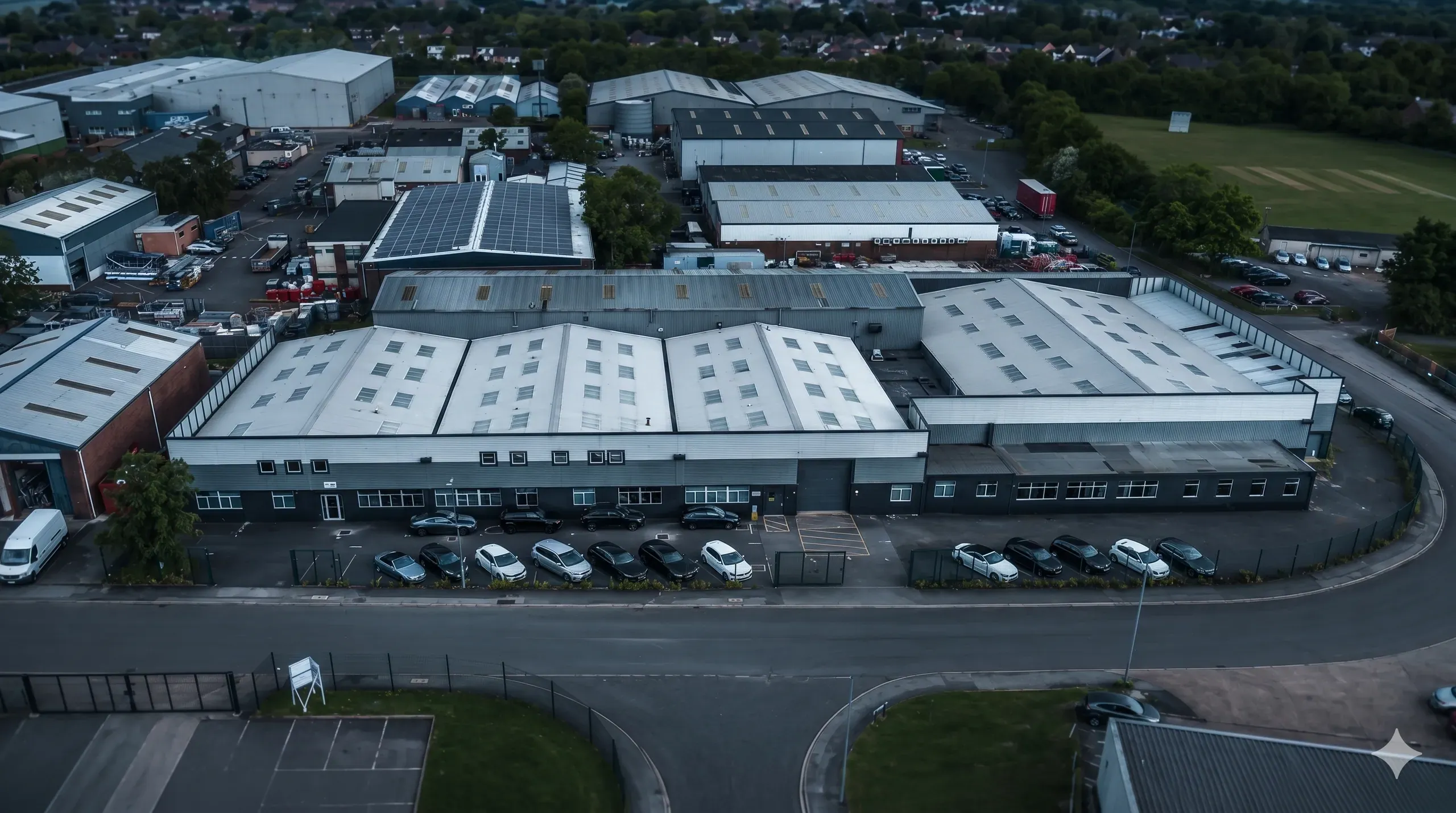
Technology & Westfield Road
The UK’s only precision production line for EV battery disassembly.
At Westfield Road in Warwickshire, GreenTech Industries runs a 3,446m² purpose-built facility and a precision disassembly line, with a proprietary digital layer in development and an IP portfolio built pack by pack since 2017.
A working production line, built for safe, scalable precision recovery of EV battery components, cells, data and remaining usable life at industrial rate.
Why this technology exists
Where the industry shreds. We recover.
The shredder route loses everything that matters about an EV battery at end of first life.
That means the components, the cells, the diagnostic data inside them and their remaining usable life.
What returns is black mass: of every tonne sent for refining, around 15 kilograms comes back usable.
That black mass is exported overseas, because UK refining capacity is too small to process it.
GreenTech Industries built the precision disassembly line that sits in front of the shredder, recovering the components, cells, data, and remaining usable life before anything is destroyed.
Built in the UK
Proprietary
digital layer
in developmentEngineered
for safetyScalable
Precision recovery at industrial rate
Built ahead of the packs now arriving. Refined on every battery since.
Westfield Road
A purpose-built facility, made for production.
Westfield Road is one of GreenTech Industries’ three Warwickshire facilities: a 3,446m² site, ten times the size of the original 352m² operation, and the home of the UK’s only precision production line for high-voltage battery disassembly. The former Vivarail premises have been engineered for production-grade work, with automotive-quality standards applied from day one.
The facility was independently assessed by Coventry University against the APC framework. It sits five miles from JLR and Aston Martin, with M40 and M45 motorway links and direct A-road connections into the Coventry–Warwick–Gaydon electrification cluster, which is also home to the UK Battery Industrialisation Centre.
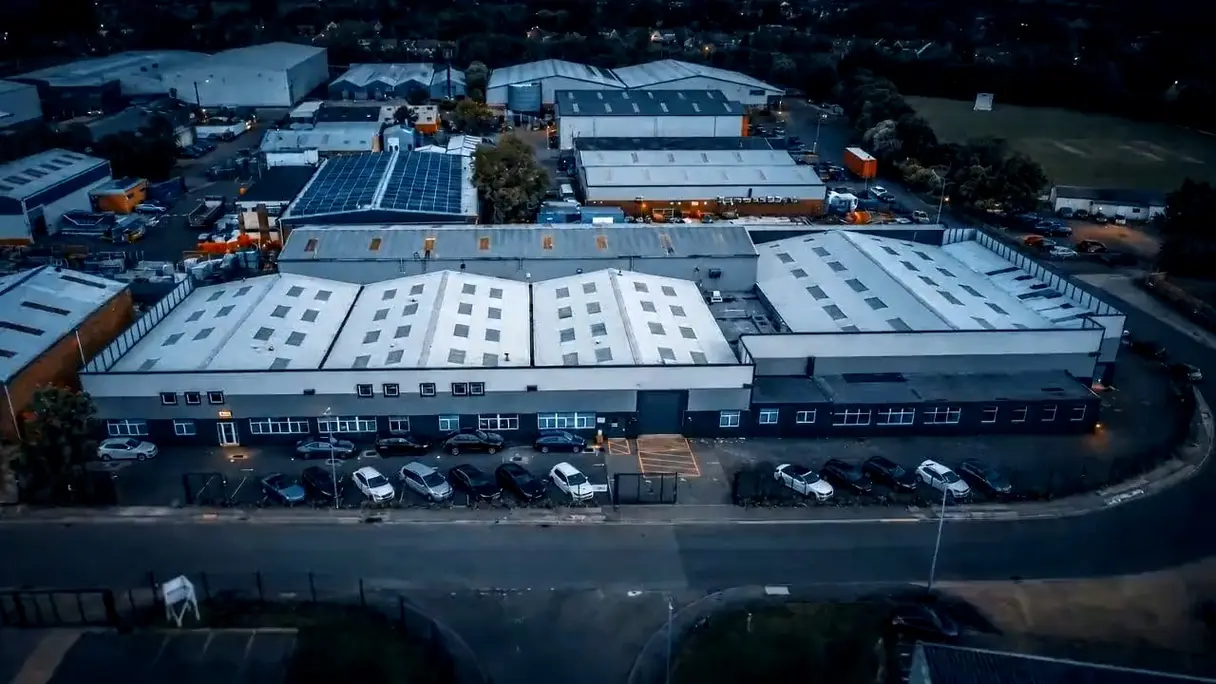
The site at a glance
More material is arriving every year, faster than the UK can process it. Westfield Road has the space to take that volume and a line built to move it, with the next phase targeting an 8× throughput uplift over today’s manual operation. The site is built to scale as UK volume grows.
3,446m²
Facility size
Former Vivarail premises, 10× the original 352m² operation.
7,400+
Phase 1 capacity
Battery systems per annum at target throughput.
5 miles
From JLR & Aston Martin
Inside the Coventry–Warwick–Gaydon electrification cluster.
APC
Independently assessed
By Coventry University against the APC framework.
Factory layout
The production line, end to end.
The layout planned for the next phase puts pack intake on one side and sorted material and recovered components on the other. Five disassembly stations form the central line, with storage racks for inbound and outbound material along the floor, and forklifts, conveyors and inspection bays laid out for the full flow from pack to component.
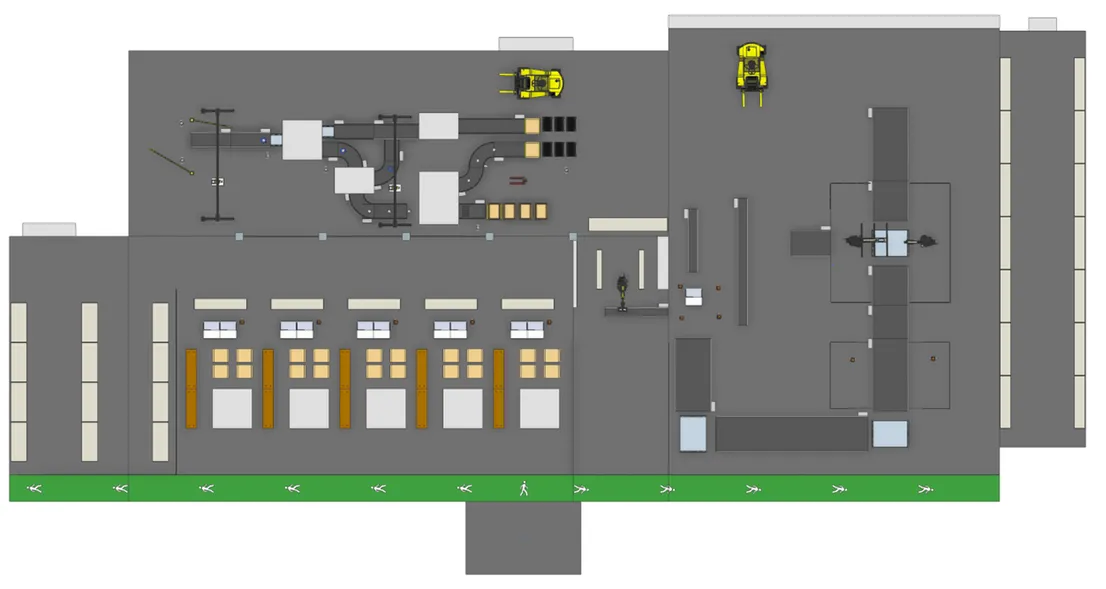
Westfield Road. A working production line for precision battery disassembly.
The line
Four stages.
The same way for every pack.
Every battery that arrives at Westfield Road moves through the same four stages of the precision disassembly line. Each stage runs to documented procedures and is recorded end to end, so every pack is handled the same way and every component is captured with full chain-of-custody data. Automating those stages is the next phase of development.
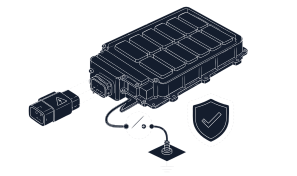
Safe
isolationThe high-voltage bus is isolated, the coolant drained and the casing removed, then every pack goes through multi-stage HV verification: isolation, bleed-down, external discharge and thermal imaging.
Every pack is made safe before anyone works on it.
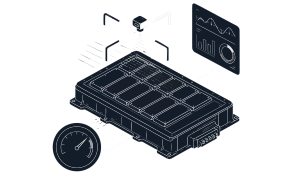
Rapid Battery Assessment (RBA)
Every pack is assessed on arrival for safety, electrical and mechanical integrity, state of health, chemistry and pack family. In the next phase, an AI-led classifier takes on this assessment.
The assessment decides how each pack is handled.
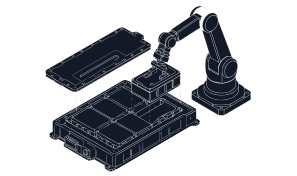
Precision disassembly
Every pack is opened and its components harvested: modules, connectors, fuses, clamps, cooling plates and busbars. The next phase brings cobots, robots and reconfigurable end-effectors to this stage, with the opening method chosen for each pack: a controlled cut, pin extraction, laser cutting along weld seams, or waterjet for bonded interfaces.
There are four lid types: bolted, pinned, welded and glued. Each needs its own opening method, and the assessment sets the right one before the pack reaches the station.
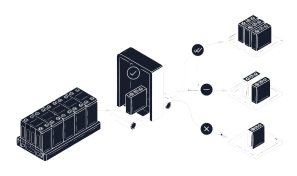
Grade &
routeComponents, modules and cells are assessed against state-of-health thresholds and routed pack by pack: into Asset Management for module-level reuse, into Product Innovation for second-life storage and replacement packs, or into refiner streams as pre-sorted, clean material. 110+ unique parts recovered per pack on average.
Every pack that arrives here leaves knowing its next purpose.
One line and one record for every pack. 74% of every pack comes back as usable components and materials.
The innovation
Conventional equipment,
used in an unconventional way.
The next phase of development on the precision disassembly line at Westfield Road, backed by DRIVE35 funding for AutoDMR and the Advanced Propulsion Centre’s Mobilise26 programme, targets an 8× throughput uplift over today’s manual operation: from 190 kg per hour to 1,500, and per-pack cycle time from around four hours to ten minutes. Those targets assume a single eight-hour shift, 232 days a year, and the line scales with extra shifts. The hardware is established. The innovation is how it will fit together, configure itself for each pack and feed operational data back into the model.
01 · Assessment
Rapid Battery Assessment
An AI-led classifier, in development, will read every pack on arrival using machine vision, open-circuit voltage measurement, X-ray and non-destructive testing, and weight and geometric comparison. It combines physics-informed and machine-learning models, targeting ≥90% accuracy across five or more pack families.
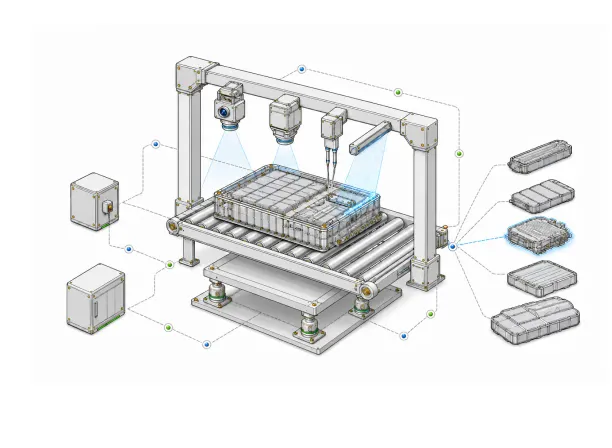
02 · Planning
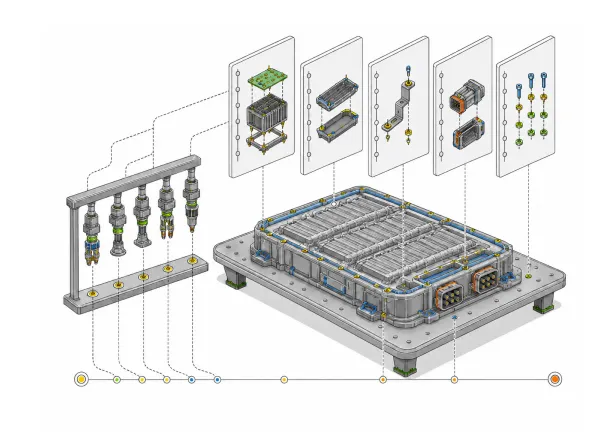
Digitised SOPs.
GTI’s standard operating procedures, covering tooling, sequencing, safety protocols and component handling at each stage, are being digitised so they can direct the equipment on the precision disassembly line.
03 · Execution
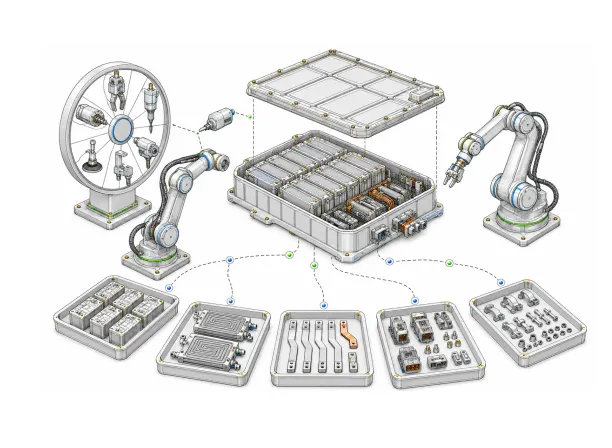
Adaptive automation.
The next phase brings cobots, robots and reconfigurable end-effectors to the line, opening every pack and harvesting its components, with the cutting method chosen automatically per pack.
04 · The lid problem
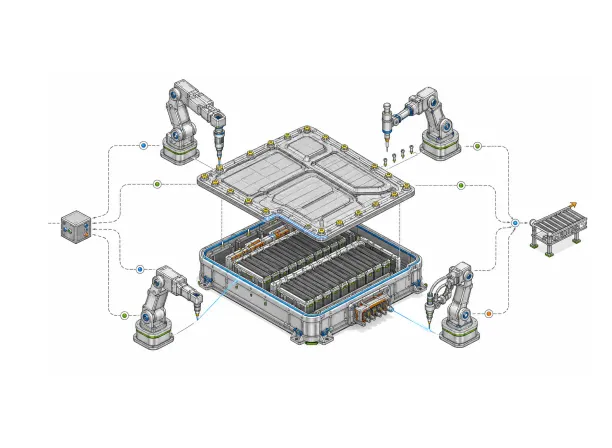
Four methods, one line.
There are four lid types: bolted, pinned, welded and glued. Each needs its own opening method, and the automated line will choose the right one before the pack reaches the station.
Speed comes from integration, fitting the process to each pack.
The digital layer
In development
A live model of the line,
built to run underneath every pack.
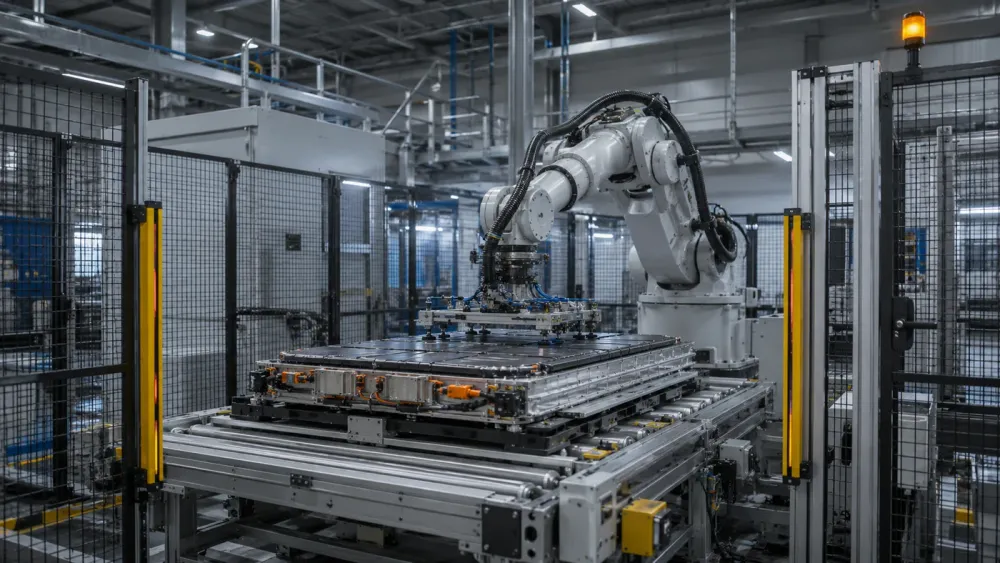
The digital twin sits at the centre of the next phase for the precision disassembly line at Westfield Road, now being scoped through the Advanced Propulsion Centre’s Mobilise26 programme and built with DRIVE35 funding for AutoDMR.
It will adapt to each pack type.
It will predict faults before they stop the line.
Everything it learns from each disassembly will feed back into the model, so the line can configure itself for each pack in real time.
- Adaptive to each battery type
- Real-time line configuration
- Predictive fault detection
- Production-grade reliability
- Full chain-of-custody data
The line will run on it, and every pack will make it sharper.
Safety & standards
Production-grade discipline,
automotive-grade standards.
The precision disassembly line is designed for safe handling of high-voltage battery packs at industrial rate, with multi-stage isolation, containment for ambiguous cases, and gas monitoring and ventilation. GreenTech Industries is certified to ISO 9001, 14001 and 45001.
Safety architecture
Safe by design
Sensors, controls, interlocks and the enclosure are designed to work as one system, so every pack is handled under controlled conditions from intake to dispatch.
Containment
EUCAR Level-7 enclosure
For ambiguous cases where pack integrity is uncertain, the line is designed to process inside a EUCAR Level-7 safety-rated enclosure, managing heat from cutting and containing any thermal events during disassembly.
Air quality
HF / CO monitoring · LEV
The line’s design includes continuous hydrogen fluoride and carbon monoxide monitoring across the disassembly stations, with local extract ventilation and HEPA and activated-carbon filtration for any gas emissions during cell exposure.
HV verification
Multi-stage isolation check
Every pack passes multi-stage HV verification before any tool touches it: isolation, bleed-down, external discharge and thermal imaging. Safe-by-default SOPs throughout.
Quality systems
ISO 9001 / 14001 / 45001
Triple-ISO certified across quality management, environmental management, and occupational health and safety. The framework automotive customers expect from their suppliers.
Workforce
Trained HV operators
GTI’s high-voltage training programme, delivered with Warwickshire College Group, produces the skilled workforce the line runs on, trained in specialist HV handling, safety and traceability from their first day.
Built this way because it keeps our people and our building safe. Every standard follows from that.
The backbone
66 IP entries.
Accumulated from every battery processed since 2017.
Every entry is developed or acquired by GreenTech Industries and owned outright, free of university and consortium claims.
Disassembly SOPs
Automation methodologies
Safe-discharge procedures
The diagnostic data asset
The HV training programme
Brand
identityNine years
of process knowledge, built on the line since 2017.