

Automotive OEMs
Closed-loop batterypack management,built to OEM grade.
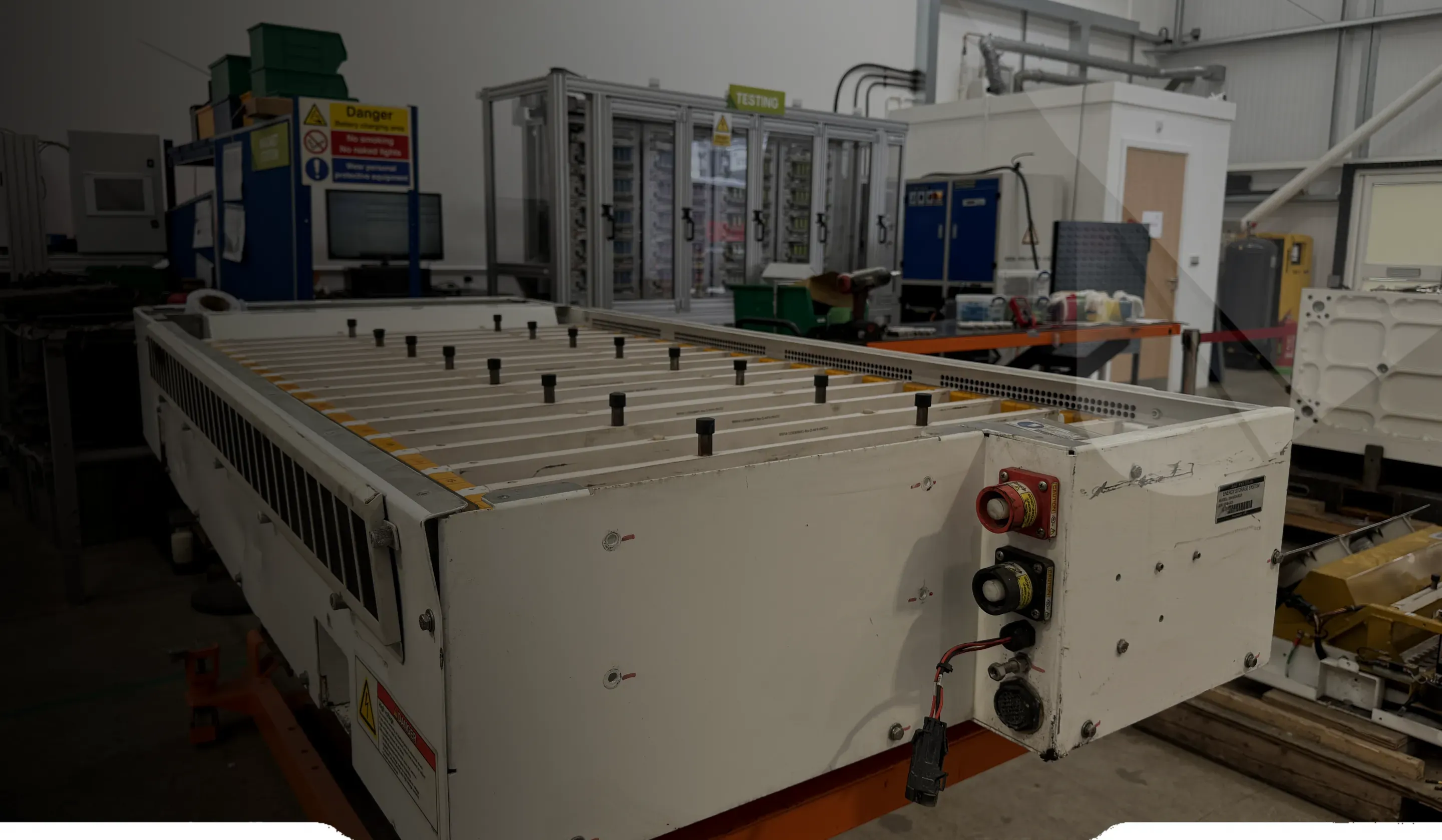
From pack collection at end of first life, through precision disassembly, module regeneration, and replacement-pack supply, all under one chain of custody and aligned with the EU Battery Regulation. The OEM-grade end-of-life infrastructure is already in place, in the UK.
What we do for OEMs
Three services
that keep your packs in your supply chain.
Every pack that leaves a vehicle has three places it can go productively before any material is shredded. GreenTech Industries runs all three under one roof, with one chain-of-custody record, one set of automotive-grade standards, and your IP and proprietary design data protected throughout.
- Explore more
retention
End-of-life pack management for production runs
The Disassembly Service
The UK’s only precision disassembly line for high-voltage EV battery packs. Full chain-of-custody from collection to dispatch. Compliance documentation aligned with the EU Battery Regulation and Duty of Care requirements. Built for OEMs managing returns at scale.
Compliance covered
- Explore more
regeneration
PPAP/PSW-grade pack and module regeneration
Asset Management
Module-level diagnostics, re-energisation, and rebuild to automotive submission standards. Compatible with OEM warranty workflows. The diagnostic record follows the asset, giving your service network real cell data instead of assumed depreciation curves.
Value retained
- Explore more
reinvention
Replacement packs for aftermarket service
Product Innovation
OEM-grade replacement packs built from validated, traced modules: PPAP/PSW compliant, fully documented, and costing less than a new-build pack. They keep vehicles serviceable that a new-build price would have parked for good.
Aftermarket supplied
Three ways back into the same supply chain.
Every kilo recovered stays in your supply chain.
The OEM reality
Compliance that earns trust.
Data that supports the next vehicle.
The EU Battery Regulation means OEMs have to evidence what happens to each pack at end of life. That takes data, documentation and a traceable material chain.
Battery passport & chain of custody
Every pack tracked from intake to material outcome. Identity, state of health, processing decisions, and downstream destination recorded against your battery’s ID. When battery passports become mandatory in 2027, the audit trail is already there.
State-of-health data per cell
Cell-level diagnostics from Rapid Battery Assessment (RBA): internal resistance, capacity, expected remaining service life. Data your engineering and warranty teams can use for next-generation pack design, warranty cost modelling, and aftermarket pricing.
PPAP / PSW-grade work
Regenerated modules and replacement packs are built to the same Production Part Approval Process and Part Submission Warrant standards your tier-1 suppliers operate under. ISO 9001 / 14001 / 45001 certified. Compatible with your warranty conditions.
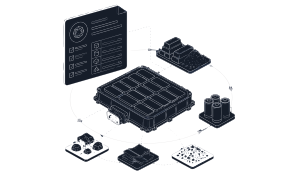
Material tracing for closed-loop supply
Separated materials go back to the right supply chain, aluminium to aluminium, copper to copper, cells to cells, with the documentation Extended Producer Responsibility regimes now require, including yours when the obligation lands.
What looks like compliance work is also your audit story. Set up now, it’s in place before the deadline lands.
What you get back
Capability, capacity,
and material flow.
The questions OEM commercial, engineering, and compliance teams ask before signing: what we handle, what we return, and how that material moves back into your chain.
15+ marques
Pack formats & brands handled
Standard operating procedures cover 15+ battery marques across large-format, cylindrical, and prismatic packs, including 26650 and 32113 cell formats. Every additional variant becomes a new dSOP, validated and added to the library.
74%
Material returned to supply
74% of every pack, including components, cells, and remaining usable life, is recovered and routed back into the right supply chain (aluminium to aluminium, copper to copper, cells to cells). That’s around 186 kg of every 250 kg pack. The rest, <3% by mass, goes to material recovery.
Cell-level
Data returned with every pack
State of health, internal resistance, capacity, and expected remaining life recorded for every cell. Returned to your engineering and warranty teams alongside the chain-of-custody record, usable for next-generation pack design and warranty cost modelling.
PPAP / PSW
Built to your suppliers’ standards
Regenerated modules and replacement packs are built to the same Production Part Approval Process and Part Submission Warrant standards your tier-1 suppliers operate under. ISO 9001 / 14001 / 45001 certified throughout. Compatible with your warranty conditions.
The same standard, on the way back through the chain, because GTI’s founders built a lot of the original programmes the packs came from.
The legislative landscape
The regulation is here.
The OEMs ahead of it set the standard
the rest get audited against.
Three regulatory shifts come back to one question: what happens to a battery once a vehicle leaves the road. A documented answer takes the compliance risk off your team and saves the time spent
defending decisions later.
What it means for your team
Battery passport, material recovery quotas, and Extended Producer Responsibility land in stages through 2027. OEMs selling into the EU need chain-of-custody and material-passport infrastructure in place before the deadline. GTI’s process is built to deliver both as standard.
What it means for your
aftermarketWhat landed for phones is landing for vehicles. Customers and regulators will expect a credible replacement-pack pathway. GTI supplies OEM-grade replacement packs that keep your service network’s answer the right one.
What it means for your
supply chainThe UK’s commitment to meet 20% of critical mineral demand through recycling by 2035 turns end-of-life material into a national-priority feedstock. OEMs with traceable recovery flows are better placed as supply partners. GTI returns recovered components, cells and materials to the chain with the documentation to prove where they came from.
The legislation is on its way, and every OEM will have to meet it. What it brings is a record of how each pack has been used, and that record is what makes the material inside it reusable. GreenTech Industries is where that reuse gets done.
How we work
Three ways into the partnership.
OEM partnerships can be structured in a few different ways, chosen based on volume, programme scope, and how the OEM wants the chain-of-custody data to flow. The underlying automotive-grade standards, chain-of-custody, and per-pack documentation are the same whichever way the relationship is set up.
End-of-life pack contracts
Mode 01Logistics, intake, precision disassembly, and full compliance documentation for OEMs managing pack returns at production-line scale, with IP and proprietary design data protected as standard. Scope and term sized to programme volume and the OEM’s chain-of-custody requirements.
What we need: volume forecast, pack format, collection geography, cell chemistry.
Aftermarket service supply
Mode 02PPAP/PSW-grade replacement packs and regenerated modules supplied into your aftermarket service network. Compatible with existing warranty workflows. Validated against your vehicle’s pack specification before service-network release.
What we need: vehicle programme spec, target service-network footprint, warranty position.
Closed-loop material partnership
Mode 03Recovered cells, components and materials, and diagnostic data routed back into your next-generation programmes. Battery-passport documentation and material provenance built in, ready for ESG reporting, EPR compliance, and supply-chain assurance.
What we need: next-gen pack roadmap, supply-chain assurance requirements, ESG reporting framework.
Whichever route you start with, the loop closes in your supply chain, with the documentation to prove it.
FAQ
Frequently asked questions
How can OEMs manage end-of-life EV battery returns?
GreenTech Industries runs three routes under one roof: precision disassembly for pack returns at production-line scale, PPAP/PSW-grade module regeneration, and replacement packs for aftermarket service. All three share one chain-of-custody record and one set of automotive-grade standards, with your IP and proprietary design data protected throughout.
Are regenerated modules and replacement packs built to OEM standards?
Yes. They are built to the same Production Part Approval Process and Part Submission Warrant standards your tier-1 suppliers operate under, certified to ISO 9001, 14001 and 45001, and compatible with your warranty conditions. Replacement packs are validated against your vehicle’s pack specification before service-network release.
What data comes back to engineering and warranty teams?
State of health, internal resistance, capacity and expected remaining life for every cell, from Rapid Battery Assessment (RBA), returned alongside the chain-of-custody record. Teams use it for next-generation pack design, warranty cost modelling and aftermarket pricing.
How do recovered materials return to an OEM’s supply chain?
Separated materials go back to the right supply chain, aluminium to aluminium, copper to copper, cells to cells, with the documentation Extended Producer Responsibility regimes now require. Under a closed-loop material partnership, recovered cells, components, materials and diagnostic data are routed back into your next-generation programmes.