

Insurance & Data
The vehicle gets written off.The data shouldn’t be.
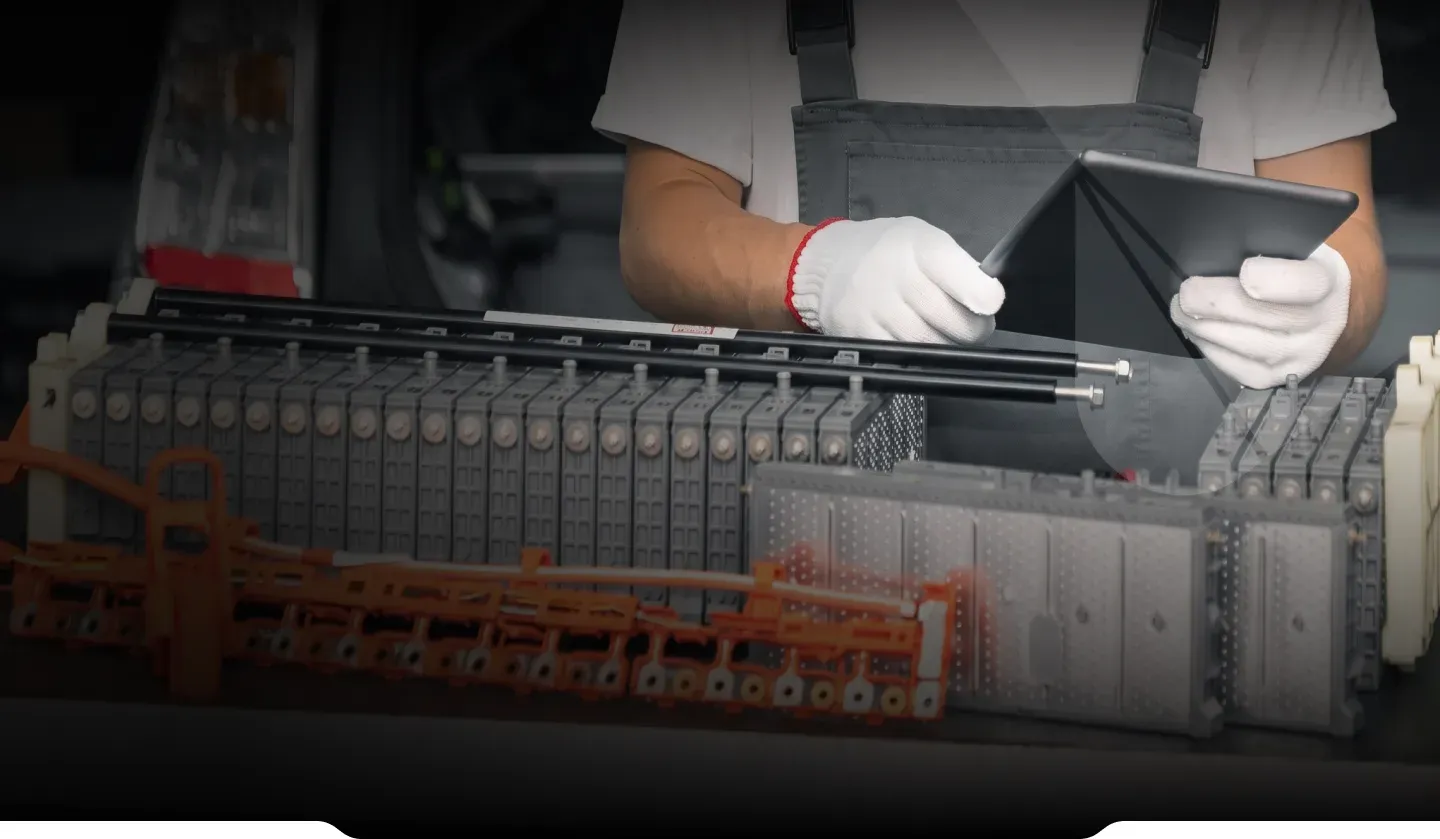
For insurers, the value GreenTech Industries recovers from a written-off EV battery is its data: per-pack teardown evidence of how serviceable it really is. Insurers can price risk on fact instead of worst-case assumption. Manufacturers and industry bodies learn what fails, what doesn’t. Our data helps build the next pack better. And the pack itself is in safe hands: anything that comes back from a crashed vehicle, collected, contained, disposed of, documented.
What we do for insurers & industry bodies
Three services
for every pack a claim touches.
Every written-off EV carries a battery question, and without data, insurers have no option but to price for the worst case. Every pack GTI opens helps change that. Each teardown records what failed and what didn’t: what the pack has really been through, and what it still has to give. Pack by pack, that builds into data the whole supply chain can use: insurers pricing risk on evidence, industry bodies advising on serviceability, manufacturers designing the next pack to come apart better. It starts with three services.
- Explore more
retention
Incident-damaged packs, handled safely
The Disassembly Service
Anything that comes back from a crashed vehicle, dealt with safely: controlled-environment intake for incident-damaged, fire-affected, or structurally compromised packs. Every pack returns a state-of-health report and serviceability data, with full chain-of-custody documentation for the claim file.
less risk
- Explore more
regeneration
Total losses where the battery is recoverable
Asset Management
Where the vehicle is a write-off but the battery isn’t, modules are tested, regenerated, and returned to supply. Value comes back into the chain instead of leaving as disposal cost, and the claim closes on evidence, not estimates.
more value
- Explore more
reinvention
Second-life packs for remediation
Product Innovation
PPAP/PSW-grade replacement packs built from validated, traced modules. Where a claim leads to repair rather than write-off, a second-life pack brings the cost of remediation down, and the cost of the claim with it.
lower cost
Three routes in, with data all the way through. The pack is handled, the claim documented and the cost known.
The insurance reality
The pack is the question.
The cost of getting it wrong is on the policy.
On every EV claim, the battery pack is an unknown: structurally damaged, depleted, or still serviceable. The answer determines what the claim costs, what the write-off is still worth, and what data you have to price the next risk.
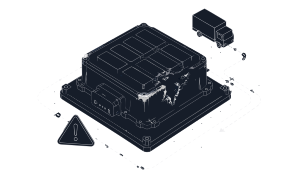
The batteries that need specialist handling
Fire-affected, crash-deformed, or thermally-compromised packs require controlled-environment intake, ADR-compliant transport, and trained HV operators. When handling goes wrong, the cost lands on the claim.
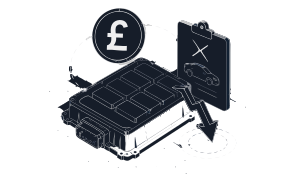
Total-loss pricing on the battery
EV battery replacement costs run between £4,000 and £20,000 across mainstream models, well above the residual value of the vehicle in many cases. The pack is what writes the vehicle off, and the cost flows straight to the claim.
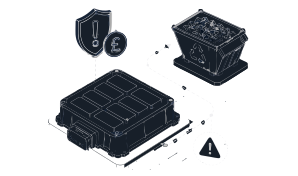
Disposal liability on every write-off
An intact battery pack with nowhere to go is pure cost. The disposal charge lands on the claim, the remaining value is shredded with it, and nothing comes back against the loss.
No real data to price battery risk on
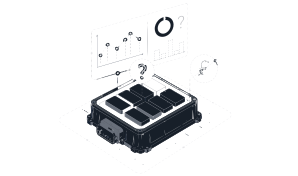
Underwriting EV battery risk currently relies on assumed depreciation curves where per-pack state-of-health data doesn’t yet exist. GreenTech Industries is co-developing a serviceability score matrix with Coventry University to give insurers a real basis for pricing it.
The pack determines what the claim costs. The data determines what the next claim costs.
What you get back
Cost off the claim.
Data into the next one.
These land on the claim file, in the underwriting decision, and in how the industry prices battery health. They come from our own disassembly line, our partnership with Coventry University, and the market as it stands today.
Serviceability score
In development with Coventry University
GTI and Coventry University are co-developing a serviceability score matrix to help insurers price battery risk, and to shape how the industry values battery health. Built on measurements from real packs on GTI’s precision disassembly line.
£4,000–£20,000
The cost a recovered pack offsets
The cost of a new pack across mainstream models, often more than the vehicle itself is worth, which is what turns repairable damage into a write-off. Where a recoverable pack returns value, or a second-life pack closes a repair, that’s the number in play.
Safe disposal
What can’t come back: IP protected
Packs beyond recovery are processed and documented through to compliant disposal, with the paperwork for your file. And every pack carries someone’s proprietary technology: disposal is handled with the IP inside it protected.
Per pack
Chain-of-custody documentation
The Duty of Care and transport documentation each collection needs, with full traceability returned per pack. Built for the claim file from the start.
Insurers and recovery networks operating with this data don’t have to guess what a battery is worth. The next time the same pack format comes in, the answer is already on file.
The legislative landscape
After the claim,
someone has to account for the pack.
Three regulatory frameworks shape what happens to an EV battery pack after a claim is settled: Duty of Care, the EU Battery Regulation and producer responsibility. A documented route gives the regulator and the policyholder the evidence each needs.
Duty of Care
What it means for your recovery chain
Already in force. Every HV pack moving through a recovery network carries a legal duty of care. Handing packs to GTI is straightforward. We arrange the most appropriate transport for each collection, wherever the pack sits in the network.
What it means for your claim file
Battery passport requirements land in stages through 2027. Claims involving vehicles registered into or operated in EU markets will increasingly need provenance and processing documentation on every pack, the kind GTI returns as standard.
Producer responsibility
What it means for your cost recovery
Responsibility for funding end-of-life processing is shifting along the chain. Insurers with traceable battery routes can show where every pack went and what came back: evidence for compliance reporting, and for the question of who pays.
The regulation comes down to one requirement: prove where every pack went. That proof already exists: chain-of-custody documentation, returned with every pack.
How we work
Three ways into the partnership.
Insurance partnerships are structured around claim volume and network footprint, from single-claim intake to standing routes to a multi-year MOU. The operating standard and chain of custody are the same whichever way in; what each route adds is scale, and at MOU level, data.
Per-claim pack intake
Mode 01Single-pack collection triggered by a specific claim or write-off file. Controlled-environment intake, state-of-health report, and disposal/recovery decision returned for the file. Useful where claim volume is unpredictable or a specific pack triggers the conversation.
What we need: claim/pack reference, pack format, current location, requested collection date.
Standing recovery-network routing
Mode 02Bulk volume routing from a recovery network on a defined cadence: scheduled pickups, agreed pack-format scope, claim-reference reporting. Suits recovery operators with predictable EV write-off volume that needs a reliable processing route.
What we need: network footprint, monthly volume forecast, pack-format mix, claim-reference format.
Multi-year insurer MOU
Mode 03Multi-year MOU covering EV pack intake, regeneration where viable, and per-claim documentation across a defined volume. Includes access to serviceability-score data outputs as the Coventry University programme matures, for the insurer and for the industry bodies advising them. Data relationships in their own right are scoped case by case.
What we need: multi-year claim-volume commitment, scope of routed pack formats, data-sharing scope, governance contact.
One standard sits behind every route, whether it moves packs, claims or data.
FAQ
Frequently asked questions
What happens to the battery in an EV write-off?
That depends on the pack: structurally damaged, depleted, or still serviceable. GTI takes incident-damaged packs in under controlled conditions and returns a state-of-health report and serviceability data. Recoverable modules are regenerated and returned to supply. Packs beyond recovery are documented through to compliant disposal.
Can a damaged EV battery be repaired rather than scrapped?
Where the vehicle is a write-off but the battery isn’t, modules are tested, regenerated, and returned to supply. Where a claim leads to repair rather than write-off, a PPAP/PSW-grade second-life pack brings the cost of remediation down, and the cost of the claim with it.
What documentation comes back for the claim file?
A state-of-health report and serviceability data for every pack, with the Duty of Care, transport and chain-of-custody records each collection needs. Built for the claim file from the start.